

There is a moment when you leave the pavement outside Moab and the trip changes.
The traffic disappears. The buildings vanish behind you. Cell service becomes less important. The tires begin crunching over dirt and stone, and suddenly the landscape that looked enormous from the highway becomes something you are actually traveling through.
This is the Moab I think people come here hoping to find.
And few drives capture it better than the journey toward Fossil Point—better known to many visitors as Thelma & Louise Point—and on toward the legendary Shafer Trail.
It is part scenic drive, part Hollywood history and part classic Moab backcountry adventure. More importantly, it is one of those places where having a capable Jeep changes what you can experience in a single day.
You aren’t simply driving to an overlook.
You’re driving into the landscape.
A Landscape Made for the Movies
Long before mountain bikers, Jeep enthusiasts and travelers from around the world began putting Moab on their bucket lists, Hollywood had already discovered something special about southeastern Utah.
The landscape here doesn’t need much help from a movie set.
Towering sandstone cliffs, empty desert roads, distant mesas and canyons carved hundreds of feet into the earth already look cinematic. Filmmakers have been coming to the Moab area for generations, using its red-rock country as a stand-in for everything from the Old West to distant planets.
But few movies are as closely connected with this landscape as the 1991 film Thelma & Louise.
Directed by Ridley Scott and starring Geena Davis and Susan Sarandon, the movie follows two women whose weekend getaway turns into a journey across the American West. Although the story supposedly carries them toward the Grand Canyon, much of what audiences saw on screen was actually filmed right here in southeastern Utah.
According to the Utah Film Commission, roughly half of Thelma & Louise was filmed within about 50 to 60 miles of Moab during the summer of 1990. Locations included the La Sal Mountains, Cisco, Arches National Park, Canyonlands National Park and the country surrounding Dead Horse Point. (Utah Film Commission)
Then there is the ending.
If you’ve seen the movie, you know the shot.
A turquoise 1966 Ford Thunderbird races toward the edge of an enormous canyon. Rather than surrender, Thelma and Louise keep driving.
The car launches into the open air.
Freeze frame.
Roll credits.
Movie history.
The “Grand Canyon” in that famous scene wasn’t the Grand Canyon at all.
It was the country outside Moab.
The Real Thelma & Louise Point
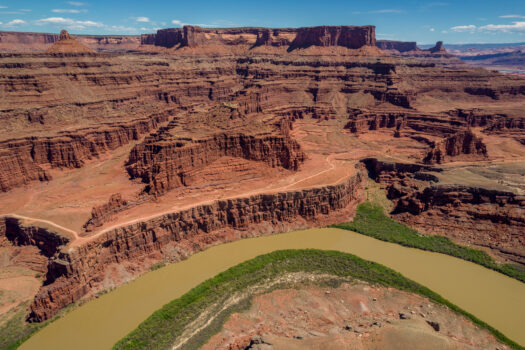
The final sequence was filmed at Fossil Point, in the backcountry below Dead Horse Point State Park. Today, it has become so closely associated with the film that most people simply call it Thelma & Louise Point.
The Utah Film Commission describes how the production crew traveled out the Shafer Trail to reach the filming location. Three identical turquoise 1966 Ford Thunderbirds were reportedly prepared for the scene. The first didn’t produce the dramatic flight director Ridley Scott wanted, so the setup was modified to launch the second car into the air.
That second attempt became one of the most recognizable endings in American film. (Utah Film Commission)
More than three decades later, you can still drive into this same country.
That’s part of what makes the experience so interesting.
Standing at Fossil Point, you’re not looking at a reconstructed movie set or a location surrounded by gift shops and ropes. You’re standing in essentially the same enormous landscape that attracted filmmakers in the first place.
And the movie connection is almost secondary to the view.
The Colorado River twists through the canyon country below. Dead Horse Point rises above you. Sandstone benches stretch toward the horizon, while distant cliffs stack themselves in layers of red, brown, gray and purple.
You begin to understand why Hollywood keeps coming back to Moab.
The landscape does most of the work.
This Is Where a Jeep Makes Sense
There are plenty of beautiful places around Moab that can be reached on pavement.
Fossil Point isn’t about that.
The experience is the road getting there.
A Jeep allows you to leave the highway behind and move at a completely different pace. Instead of seeing southeastern Utah through a windshield at 60 miles per hour, you’re traveling slowly through washes, around sandstone formations and across broad desert benches.
Windows down.
Dust behind you.
Red cliffs ahead.
You stop when you want to stop.
That’s the appeal of exploring Moab’s backcountry in a Jeep.
The vehicle isn’t simply transportation to the attraction.
The drive is the attraction.
There are places where you may want to pull over just because the light is hitting a cliff perfectly. There are spots where you can get out, stretch your legs and realize you haven’t heard another vehicle for several minutes.
And then you’ll round another corner and see the Colorado River hundreds of feet below.
This is the kind of Moab experience that’s difficult to understand from photographs.
You need some dust on the tires.
Don’t Just Visit the Point—Make It a Journey
One of the biggest mistakes visitors make when exploring Moab is thinking only in terms of destinations.
They want to “see” Arches.
They want to “see” Canyonlands.
They want to “see” Dead Horse Point.
Those places are spectacular, but some of my favorite Moab experiences happen between the famous destinations.
Fossil Point is a perfect example.
You could make Thelma & Louise Point your objective, take your photographs and turn around.
But with the right vehicle, enough time and appropriate road conditions, you can turn the experience into something much bigger by connecting this country with Potash Road and the Shafer Trail.
Now you aren’t just visiting a movie location.
You’re crossing one of the most spectacular pieces of canyon country in Utah.
Linking Fossil Point With the Shafer Trail
Shafer Trail is one of those roads that seems almost impossible when you first see it.
From the Island in the Sky district of Canyonlands National Park, the road drops dramatically through the cliffs in a series of switchbacks carved into the canyon wall.
From above, vehicles look like toys.
From behind the wheel, the scale becomes very real.
The route has a history stretching well beyond modern recreation. The Shafer country was used by ranchers and later became associated with the uranium boom that transformed Moab in the middle of the 20th century. Roads through this landscape that once served working purposes eventually became some of the most famous backcountry routes in the American Southwest.
Today, Shafer Trail gives visitors an extraordinary opportunity to experience the transition between the high mesa country of Canyonlands and the Colorado River corridor below.
Combining Fossil Point and Thelma & Louise Point with this route creates something rare: a backcountry loop where the scenery continuously changes.
One minute you’re looking across open desert.
Then you’re beneath towering sandstone walls.
Soon the Colorado River appears.
Eventually you’re staring upward at cliffs you may have been standing on top of earlier that day.
The scale of Canyonlands suddenly makes sense.
Seeing Canyonlands From the Bottom Up
Most visitors experience Canyonlands National Park from overlooks.
There is nothing wrong with that. Island in the Sky contains some of the finest viewpoints anywhere in Utah.
But there’s a difference between looking into canyon country and being down inside it.
From the overlooks, everything appears almost abstract. The cliffs become lines. Roads become tiny scratches in the desert. The Colorado River can seem impossibly far away.
Drive into the backcountry and those proportions change.
Cliffs that looked small from above suddenly tower over your Jeep.
The river becomes part of the landscape beside you.
The road you saw from the overlook is now beneath your tires.
That’s why I think exploring this area by Jeep is one of the best ways to understand Moab.
You experience the vertical scale of the place.
You don’t just look down into Canyonlands.
You travel through it.
Bring a Camera—and Give Yourself Time
This isn’t a drive I’d rush.
Fossil Point and the surrounding country are incredibly photogenic, but the best photographs aren’t necessarily at the official destinations.
Watch the light.
Morning and late afternoon can transform the landscape. Shadows stretch across the canyon walls and bring out geological layers that almost disappear beneath the midday sun.
Clouds make things even better.
A summer storm building over the La Sal Mountains can turn an already dramatic landscape into something spectacular.
And sometimes the best thing to do is put the camera away.
Turn off the Jeep.
Walk a safe distance from the road.
Listen.
One of the things that surprises people about the desert is how quiet it can be. Away from town and the highway, there may be nothing but wind moving through the brush.
That silence is part of Moab too.
Respect the Edge
The same landscape that makes this area spectacular demands respect.
There are enormous cliffs throughout this country, including at Fossil Point. There aren’t guardrails protecting every viewpoint, and the sandstone near an edge isn’t a place to test your nerves.
Stay well back from cliff edges. Keep children and pets close. Never position yourself—or a Jeep—near an edge simply to get a better photograph.
Backcountry travel also requires preparation.
Carry more water than you think you’ll need. Bring food, sun protection and clothing appropriate for changing weather. Make sure someone knows where you’re going. Conditions can change quickly after storms, and dirt roads that are easy when dry can become very different when wet.
Most importantly, stay on designated routes.
Moab’s desert can look indestructible, but it isn’t. Biological soil crusts and desert vegetation can take decades to recover after being driven over.
The goal should always be simple:
Enjoy the backcountry without leaving evidence that you were there.
A Different Side of Moab
Moab’s famous landmarks deserve their reputation.
Delicate Arch should be seen.
Dead Horse Point should be seen.
Grand View Point should be seen.
But if those are the only places you visit, you’ve seen only one version of Moab.
The backcountry is different.
Out here, there may not be an entrance station or a paved parking lot telling you that you’ve arrived somewhere important.
Sometimes it’s just a dirt road disappearing around the next bend.
That’s precisely why I like it.
Fossil Point has Hollywood history attached to it, and that makes the trip fun. You can stand in the landscape where one of cinema’s most famous endings was created and look across the same canyon country Ridley Scott put on the big screen.
But you don’t need to be a Thelma & Louise fan to appreciate this place.
The scenery is enough.
Build the Kind of Moab Day You’ll Remember
Start early.
Grab some breakfast in town, load plenty of water into the Jeep and head toward the Colorado River.
Take your time.
Explore Potash Road. Stop to look at the canyon walls. Head into the backcountry toward Fossil Point and stand in the landscape that became Thelma & Louise’s “Grand Canyon.”
Then keep exploring.
Connect into the Shafer Trail country and watch the desert change around you. If your route, conditions and park regulations allow, climb the famous Shafer switchbacks toward Island in the Sky.
Eventually you’ll find yourself back on pavement.
The tires will be dusty. Your camera will probably contain far more pictures than you intended to take.
And Moab will look different than it did that morning.
That’s what a good backcountry drive should do.
Find Your Own Moab Story
People sometimes ask what makes Jeeping around Moab so special.
I could talk about four-wheel drive, famous trails or the capability of a Jeep Rubicon.
But that’s not really the answer.
The answer is access.
A Jeep opens the door to a version of southeastern Utah most visitors never experience. It lets you move beyond the highway and discover places where the journey matters every bit as much as the destination.
Fossil Point is one of those places.
Come because you’ve seen Thelma & Louise.
Come because you want to photograph the Colorado River.
Come because you’ve always wanted to drive Shafer Trail.
Or come simply because a dirt road heading into the red rocks looks more interesting than another afternoon on pavement.
More than 30 years ago, Ridley Scott looked across this landscape and saw the American West he’d imagined for the final scene of a movie.
Standing at Fossil Point today, it’s easy to understand why.
The cliffs are still here.
The Colorado still winds through the canyon below.
The desert still stretches toward the horizon.
And unlike Thelma and Louise, you don’t have to drive off the edge to make the trip memorable.
Just turn around, point the Jeep toward Shafer Trail, and keep exploring.